TCC Comes to School: Helping Children Glimpse the Future


As the world changes rapidly, the future children face is already different from the past.With the continued growth of digitalization, automation and AI, industry needs more than manual labor or a single skill. Increasingly, it values the ability to understand technology, use tools, analyze information and work with systems to complete tasks. This shift is happening not only in workplaces: it is also becoming an important issue that education must address early.
TCC Group has long invested in industrial development and sustainability. In recent years, its transformation has included digital and intelligent approaches to industry, alongside a further question: as businesses change, can the next generation begin understanding future trends earlier? As work shifts from intensive manual labor toward equipment assistance, system integration and human–machine collaboration, can children encounter these concepts while growing up and develop an initial understanding of the world ahead?
With that belief, TCC Group launched its 2026 AI future empowerment initiative in elementary schools serving Indigenous communities. It aims to turn its observations about the future into educational content connected with children’s lives and learning. Students living near its facilities, including many employees’ children, can encounter technology, understand digital transformation and gradually develop foundational capabilities for the future in their familiar school environment.

On April 10 and April 22, 2026, TCC Group partnered with Jing-Yeu International Ltd. to deliver a series of AI and digital learning courses at Dong Ao Elementary School in Yilan and Heping Elementary School in Hualien. Rather than offering a single isolated activity, the program was designed progressively: students first developed conceptual understanding, then connected it with everyday technology, and finally learned through practical activities and interaction. The “future” became something they could see, feel and even explore with their own hands.
For TCC, these school courses are both a concrete commitment to local communities and education, and a long-term vision for the next generation’s capabilities. Beyond today’s learning, the company is considering how children can better understand the digital world and find their place in a rapidly changing environment.
Among the courses, one of the most engaging activities, bringing technology directly to life for students, was Jing-Yeu International’s drone soccer experience.
Starting with Industry: Understanding That Drones Are More Than “Flying Toys”
The lesson began with applications across industries rather than putting students straight onto the controls.
The instructor explained that drones already operate in many industrial settings. Agricultural inspections, construction surveys, bridge and building safety inspections, disaster assessment, environmental monitoring, filming and logistics all show that drones are more than a novelty: they are important tools used extensively in the real world.

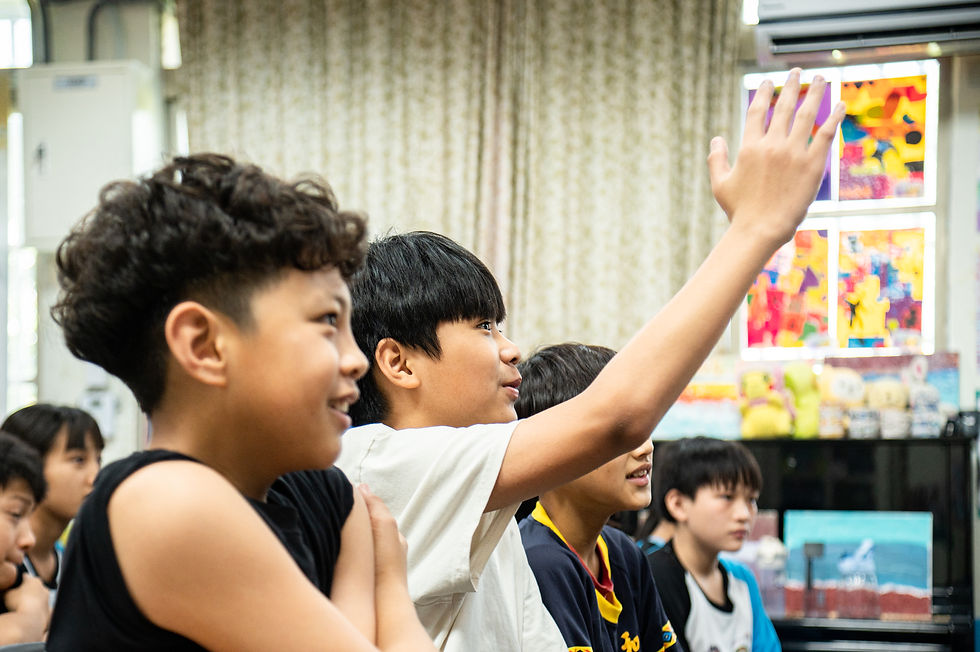
For many elementary school students, this may have been the first realization that flying equipment can do more than take photographs and videos. It can help inspect, observe, analyze and carry out tasks. Understanding these functions and their value makes it easier to see that future technologies are not remote ideas: they enter everyday life and work, and can affect how society operates.
This apparently basic introduction mattered. Understanding the purpose first meant the practical activity could be more than “fun.” Students could recognize how each control movement and flight decision might relate to a real job or professional application.
Camera Drones and the Wider Drone Family: A Fuller Understanding of Technology
The instructor also explained the difference between drones in general and drones used for aerial photography.
People often describe all flying equipment as camera drones, but aerial photography is only one of many applications. Drones in the broader sense can carry out inspections, surveys, monitoring, competitions and training as well as filming. Their designs, operating methods and technical priorities differ according to the task.


This explanation helped children see that technology is more than its outward appearance or a single function. Tools have different categories and purposes, each connected with particular professional fields.
Building this understanding develops more than knowledge. It encourages students to ask not only what a tool is, but what it can do, why it is designed that way and how it helps people work.
This is an important part of technology education for the future.
Introducing Global Competitions: Technology Learning Can Be Challenging and Exciting
Once students understood the basics of drones, the course introduced international drone soccer competitions.
The topic was unfamiliar and exciting. Students discovered that drones can become a competitive activity combining technical operation, strategy and teamwork as well as serving industry. The instructor explained the basic rules, competition format and team roles. Students began to see that this was not simply a race to fly fastest, but a technology sport requiring steady control, spatial judgment, quick reactions and coordinated teamwork.

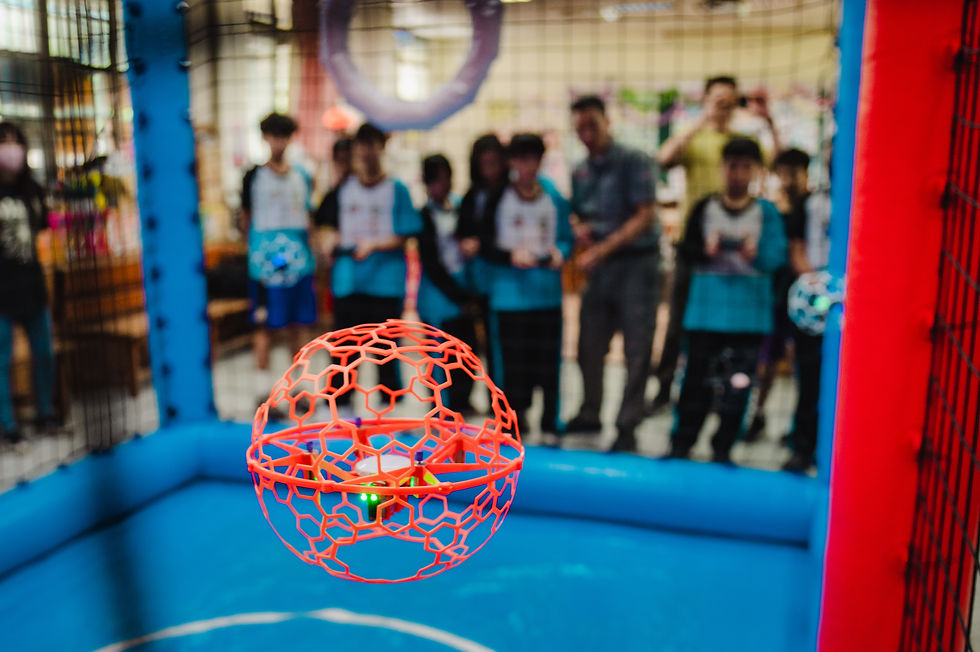
Drone soccer is a useful example of innovation in technology education around the world. It turns abstract flight-control concepts and technical training into an activity that students can experience, engage with and want to attempt. As they learned the rules, children began to see technology lessons differently: learning could involve missions, goals and the excitement of responding in the moment, rather than just sitting and listening.
This part of the lesson increased engagement and helped students move naturally from understanding technology to wanting to try it themselves.Bringing the Arena to School: Hands-on Technology for Every Student
To move beyond conceptual understanding, Jing-Yeu International brought a dedicated drone soccer arena and equipment onto campus so that children could see, handle and experience them in person.

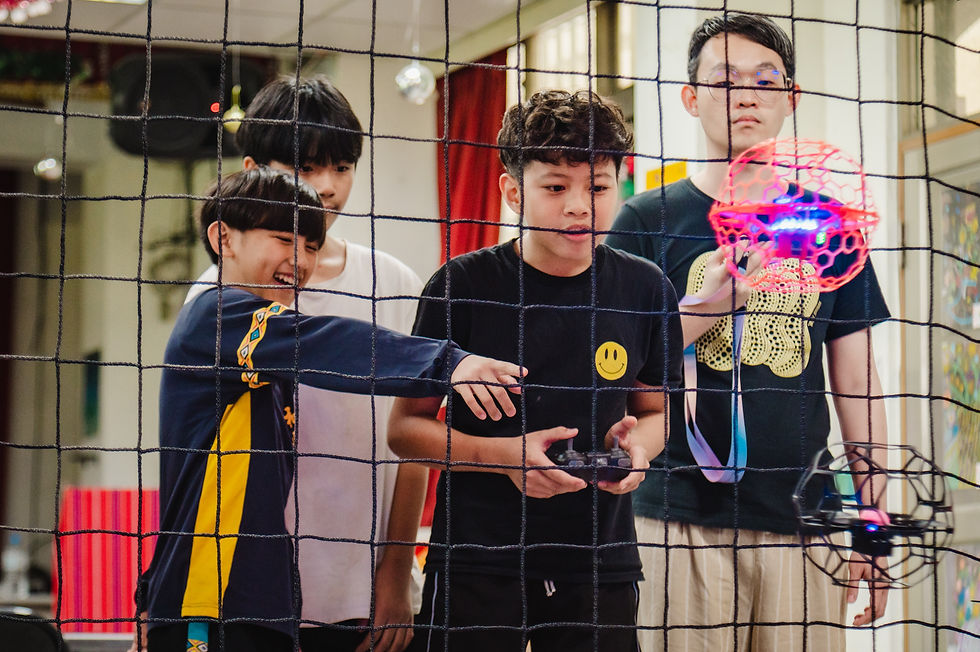
The spherical protective cages immediately energized the room. To students, this was more than a teacher bringing in a machine: it felt like a miniature international competition had arrived at school. Initial curiosity turned into focused listening and eagerness to participate, drawing both their attention and emotions into the lesson.
Before students took the controls, the instructor carefully explained safety, basic operation, equipment characteristics and the rules. For elementary school children, that guidance is essential: technology experiences should offer more than novelty and excitement, providing a clear structure in which students can learn with confidence.

As students took turns in the arena, exclamations and laughter filled the space. Some were initially nervous about moving the sticks too far; others constantly adjusted direction and height to steer the ball toward its target. Every successful passage, approach to the goal and near miss kept everyone engaged and interacting.
Most encouraging was that children were not merely watching. They moved through a complete learning process in a short time: seeing, understanding, trying, adjusting and gradually finding their rhythm.
From Fun to Meaning: Drone Soccer as a Lesson in Human–Machine Collaboration
At first glance, drone soccer may look like a novel and entertaining activity. Its deeper value is that it turns abstract skills training into a learning process children can experience personally.
While flying, students must control direction and altitude, judge distance, correct errors and complete a task within a limited space. It may look like a technology game, but it develops fundamental skills needed for future human–machine collaboration.
In a digital and automated world, people’s essential role is no longer simply to do every task themselves. They must understand how to operate tools, assess situations, issue instructions and make corrections and decisions as machines work. These abilities may be difficult to understand from textbooks alone, yet children can experience them naturally through drone soccer.


TCC Brings a Vision of the Future to School; Jing-Yeu International Makes Technology Understandable
The significance of this TCC-commissioned school program goes beyond providing educational resources. Drawing on its experience of industrial transformation, TCC turned its observations about the future into learning opportunities children could encounter early.
As the delivery team, Jing-Yeu International used professional lesson planning, a clear learning sequence and a complete on-site equipment and activity setup to turn TCC’s vision into a technology lesson children could understand, see, play with and experience.
From industrial applications and the difference between camera drones and other drones, to international drone soccer rules and an on-campus arena experience, each element had a clear purpose. Together, they guided students progressively closer to technology and the future.
Children Do Not Have to Wait Until Adulthood to Glimpse the Future
Students left with more than a new flying experience or a little extra knowledge about drones.
More importantly, they began to understand that the world and the way people work are changing. They do not have to wait passively for that future: starting now, they can gradually get to know technology, understand it and learn to accomplish more with it.

By bringing AI and drones into schools, TCC did more than organize an event: it opened a window. Through it, children saw not just flying equipment, but one possible form of the future; not just competition and controls, but deeper connections between industry, education and skills development.
In such partnerships, Jing-Yeu International continues to bridge industry needs and classroom practice. Technology becomes more than an impersonal term: it becomes a learning experience filled with warmth, imagination and possibility.
A drone soccer lesson may be brief, yet it can become a distinctive memory for a child.
That day, they did more than see technology. For the first time, they truly felt that—
the future was not so far away after all.
Watch the full video on YouTube!
To learn more, call Jing-Yeu International or contact us through our official LINE account. 🙌
👇 Add our official LINE account for the latest events and teaching resources. 👇
👇 LINE ID: @244abdrd. You can also scan the QR code below! 👇


Comments